
VD, Alsona
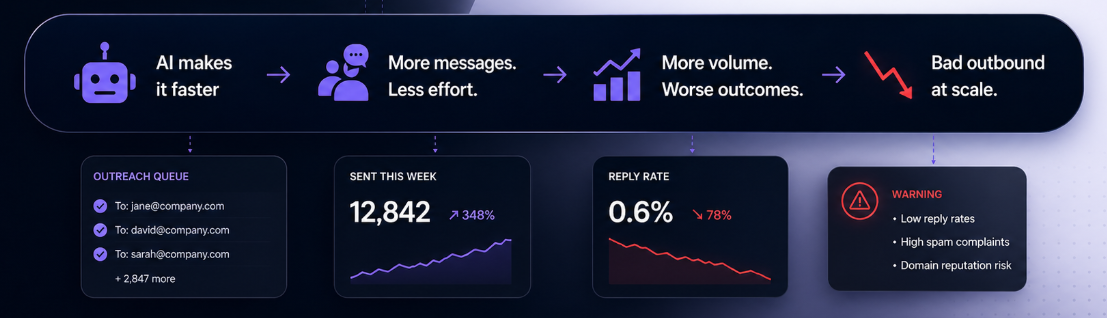
AI did something uncomfortable to outbound.
It made the lazy version easier.
A few years ago, writing a bad outbound campaign still took work. Someone had to build the list, write the copy, make the variants, load the sequence, check the steps, and keep the campaign moving.
Now, a team can generate a full campaign in minutes.
That is useful. AI can save a huge amount of time across research, writing, follow-ups, replies, and reporting.
The problem is what happens when teams use AI to skip the thinking.
Bad outbound used to be limited by manual effort. AI removed that limit. Now the inbox gets flooded with messages that are longer, cleaner, and somehow even less specific than before.
Bad outbound has been around for a long time.
Generic messages. Fake personalization. Long follow-ups. Pushy CTAs. Campaigns built around the seller’s goals instead of the buyer’s context.
AI did not invent any of that. It just made those mistakes easier to repeat.
A weak prompt can produce a polished message that still says nothing. A campaign builder can generate five follow-ups that all make the same point with slightly different wording. A sales team can create dozens of message variants without stopping to ask whether the angle is worth sending.
That is the awkward part.
AI can make bad outbound look better on the surface. The grammar improves. The structure improves. The message sounds more complete.
But the buyer still reads it and thinks, “Why are you sending this to me?”
That is the question most outbound campaigns fail to answer.
A lot of teams treat AI as a writing tool.
They ask it to make a message shorter, friendlier, more direct, more professional, more casual, or more personalized.
Those edits can help, but they do not solve the main issue.
If the message is irrelevant, better wording only makes the irrelevance smoother. A prospect does not reply because the sentence structure is nice. They reply because the message connects to something they care about, at a time when they are willing to pay attention.
That connection is where weak outbound falls apart.
The campaign starts with a list that is too broad. The message leads with a generic value prop. The follow-up repeats the same idea. The CTA asks for time before the prospect has a reason to give it.
AI can rewrite that campaign ten different ways. It will still be weak if the core reason to care is missing.
There is a strange confidence that comes with AI-generated copy.
A blank page feels uncertain. A polished campaign draft feels finished.
That is risky.
When AI gives you a complete sequence, it is easy to move faster than your judgment. The campaign looks ready because every step has words in it. The follow-ups are formatted. The tone seems fine. The structure makes sense.
But a complete campaign is not the same as a good campaign.
Someone still needs to ask harder questions. The right questions usually happen before the campaign is loaded, not after the first hundred messages have already gone out.
Is this the right audience? Is the angle strong enough? Would this feel relevant to the buyer? Are we assuming a problem we have not earned? Are we asking for too much too early?
AI can help answer those questions, but only if the platform is built to do more than generate copy.
Outbound tools have always had a volume problem.
The easier it gets to send, the easier it gets to send too much.
AI adds fuel to that. Teams can create more campaigns, more variants, more follow-ups, and more “personalized” lines with less effort. That does not automatically lead to better outreach. It can just lead to more noise.
Buyers already know what mass outreach feels like. They can spot messages assembled from public data and vague assumptions. They can tell when a sender is pretending to know their business after reading one line from their LinkedIn profile.
AI-generated outreach can make this worse when it tries too hard.
The message mentions a recent post, a company update, a job title, a funding event, and a business challenge, then pivots into a meeting request. It feels overbuilt. It feels artificial.
Sometimes the better message is shorter, calmer, and more selective.
AI should help with that too.
The best use of AI in outbound is not sending more messages.
It is making better decisions before sending anything.
A strong AI outbound platform should help teams slow down at the moments that matter. Before a prospect enters a campaign, AI should help determine whether that person is actually a good fit. Before a message sends, it should check whether the angle makes sense. Before another follow-up goes out, it should ask whether the next message adds anything useful.
That kind of judgment is hard to do manually across hundreds of prospects and multiple campaigns. It is also the part of outbound that most affects performance.
The goal should not be to send every possible message faster. The goal should be to avoid the messages that never should have been sent.
That is where AI can make outbound better instead of louder.
Outbound has a buyer experience whether teams admit it or not.
Every connection request, email, follow-up, profile view, and reply shapes how someone feels about your company.
A messy campaign can make a decent brand look careless.
The risk is higher with AI because the system can act faster than a human can review. If the prompts are loose, the targeting is weak, or the workflow is too aggressive, the damage scales quickly.
This is why AI outbound needs clear boundaries. The system should know when to keep replies short, when to avoid making claims the company cannot support, and when to hand the conversation to a human. It should stop after a negative response. It should avoid pressuring someone who only showed mild interest.
AI should make the buyer experience feel more considered, not more automated.
A lot of AI outbound is just old personalization with more words.
“I saw your recent post about sales leadership and noticed your company is growing. Since you’re focused on scaling pipeline, I thought it made sense to reach out.”
That may be technically personalized. It may also feel like a machine stitched together a few public facts.
Personalization only works when it supports a relevant point.
If the prospect’s post has no real connection to the offer, leave it out. If the company update does not change the reason to reach out, skip it. If the sentence sounds like it could be generated for anyone with the same title, rewrite the angle.
AI should not add context for decoration.
It should use context to choose a better reason to start the conversation.
Follow-ups are where bad outbound often becomes unbearable.
The first message is generic. The second message asks if they saw the first. The third adds pressure. The fourth tries to be clever. The fifth pretends this is the final note.
AI can create those follow-ups instantly.
That does not mean they should be sent.
A useful follow-up should add something. It might clarify the reason for reaching out, shift the angle based on the prospect’s role, or give the person an easier way to respond. Repeating the same pitch in a slightly different tone is not a strategy.
AI should be able to spot that.
If the next step does not add anything useful, the better move may be to stop.
AI can do a lot of the work that used to slow outbound teams down.
It can research prospects, draft copy, suggest angles, manage workflow logic, summarize replies, and point out weak spots.
But someone still has to own the standard.
That standard is mostly about taste and restraint. Would we be okay receiving this message? Does this sound like us? Are we making a claim we can defend? Are we contacting people who might actually care? Are we giving the prospect an easy way to respond?
Human review matters most before scale. Once a campaign is live, the system can move quickly. The judgment needs to happen early, then continue through performance checks and reply review.
AI can assist that judgment. It should not replace it entirely.
AI-generated copy is already everywhere.
That alone will not separate strong outbound teams from everyone else.
The next phase is AI that helps with campaign judgment.
The better tools will help teams build from a clear ICP, choose the right angle, score fit, check message quality, manage channel timing, read replies, find weak points, and improve campaigns while they run.
That is where AI starts to fix the problem it helped create.
Bad outbound got easier. Now the better tools need to make careless outbound harder.
They need to slow teams down in the right places, flag what does not make sense, and push the campaign toward relevance before it reaches the buyer.
More messages will not save outbound.
Better decisions might.