Director general, Alsona
Most teams have an ICP somewhere.
It might live in a sales deck, a Notion doc, a CRM field, a founder’s head, or a half-finished strategy worksheet from last quarter.
The ICP usually sounds reasonable.
Mid-market SaaS companies. Sales teams with 10 to 50 reps. Agencies serving B2B clients. Recruiting teams hiring for hard-to-fill roles. Founders selling high-ticket services.
Then the campaign goes live and somehow the ICP disappears.
The source is too broad. The message is generic. The follow-up does not match the buyer. The CTA asks for a meeting before the prospect has a reason to care.
The strategy was there. It just never made it into the campaign.
That gap is where a lot of outbound fails.
AI can help close it.
A clear ICP is useful, but it is only the starting point.
It tells you who you want to reach. It does not automatically tell you what source to use, which prospects to prioritize, what angle to lead with, how to write the first message, what the follow-up should say, or when to stop.
Those decisions happen at the campaign level.
This is where many teams struggle. They spend time defining the right customer, then build outreach that could apply to almost anyone.
For example, a company may define its ICP as B2B agencies with 5 to 50 employees that sell lead generation services. That is specific enough to be useful.
But if the campaign message says, “We help teams improve outbound and book more meetings,” the ICP work barely shows up.
An agency owner does not need a broad sales pitch. They need a reason to believe the platform can help them manage client campaigns, protect margins, reduce manual work, or deliver better reporting.
The ICP should shape the message. If it does not, it is just a planning exercise.
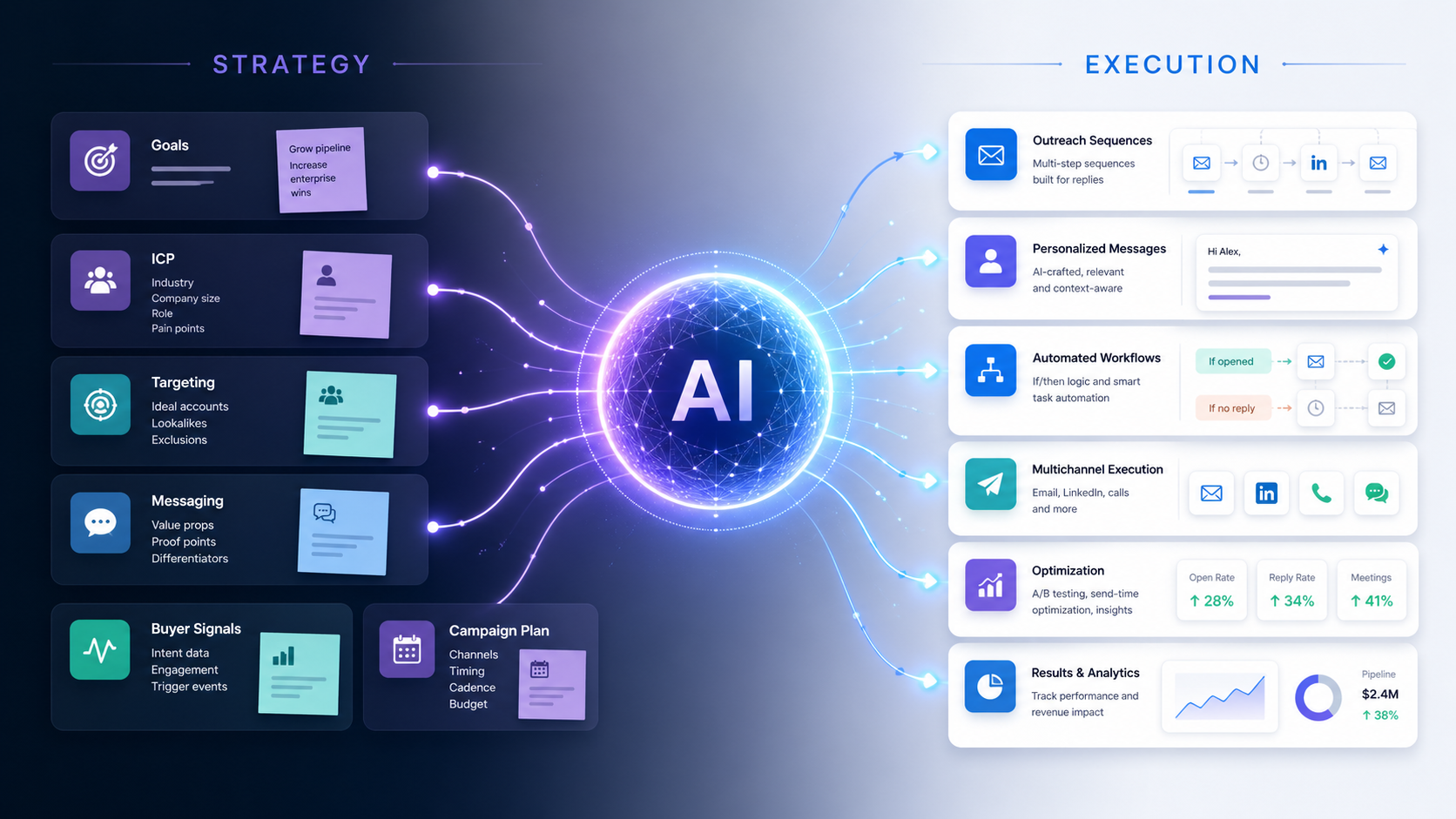
AI is useful here because it can take the information teams already have and turn it into campaign inputs.
A strong ICP may include industry, company size, buyer role, pain, buying triggers, objections, current process, and desired outcomes. AI can use those details to suggest audience segments, message angles, workflow paths, and follow-up logic.
The result is not a campaign built from a blank page.
It is a campaign built from the customer strategy.
For example, if the ICP is agency owners managing outbound for multiple clients, AI can suggest a campaign angle around client workload, campaign consistency, multi-seat management, and reporting. If the ICP is founder-led B2B companies, the angle may focus on starting outbound without hiring a team. If the ICP is recruiters, the workflow may need to speak more to candidate response and speed.
The same product can support different customers. The campaign should not treat them all the same way.
Before writing copy, AI can help decide who should enter the workflow.
This sounds basic, but it matters.
A lot of outbound campaigns start with a source that is close enough. A LinkedIn search. A Sales Navigator filter. A CSV from a database. A CRM list. A past campaign.
Close enough is where problems begin.
If the ICP says “B2B agencies selling lead generation services,” the source should not quietly include business coaches, branding consultants, solo freelancers, HR firms, and software vendors unless the campaign has a reason to include them.
AI can review the source against the ICP and flag drift before the campaign runs.
It can help separate strong-fit prospects from weak-fit prospects. It can suggest segments that need different messaging. It can find contacts who match the title but not the buying context.
That is one of the easiest ways to improve outbound before the first message sends.
A cleaner campaign starts with a cleaner source.
Once the audience is clear, the next question is why that person should care.
This is where the ICP needs to become more than a profile.
A buyer role tells you who the person is. The message angle explains why the outreach may be relevant to them.
AI can help match the ICP to the strongest angle.
An agency owner may care about managing more clients without hiring more campaign staff. A VP of Sales may care about creating more qualified conversations from the same team. A founder may care about getting outbound moving without spending their own day writing follow-ups. A recruiter may care about reaching candidates across LinkedIn and email without losing track of replies.
The campaign should lead with the angle that fits the buyer’s world.
This is also where AI can prevent shallow personalization.
Adding the prospect’s company name is not enough. Mentioning their job title is not enough. The message needs to connect the offer to a problem that role is likely to own.
AI can help make that connection more specific.
An outbound workflow is more than a sequence of steps.
It is the path you expect a prospect to move through.
That path should change based on the ICP and campaign goal.
A campaign for agency owners may need a softer first touch, a follow-up that speaks to client delivery, and an email that gives more context around managing campaigns at scale. A campaign for sales leaders may need a sharper connection to pipeline and team performance. A campaign for recruiters may need a faster route to a practical question because the use case is more immediate.
AI can help shape that workflow based on the buyer and the goal.
It can suggest whether LinkedIn should come first, when email should enter, how long to wait between touches, and what each message should add. It can also spot when the workflow is asking too much too early.
That last part is important.
A cold prospect does not always need a meeting request on the first touch. Sometimes the better move is to start a conversation, ask a lighter question, or lead with a use case that makes the next step feel natural.
The ICP should affect that choice.
Follow-ups often lose the thread.
The first message may be written for the right audience, but the follow-ups slowly turn generic.
“Just checking in.”
“Wanted to see if this was relevant.”
“Thought I’d bring this back to the top.”
Those messages do not build on the ICP. They just keep the sequence alive.
AI can help write follow-ups that stay connected to the buyer’s likely priorities.
For an agency owner, one follow-up might speak to keeping client campaigns organized. Another might lower the ask by mentioning reporting or workflow consistency. For a founder, a follow-up might focus on saving time or starting outbound without building a large sales motion.
The point is not to make every follow-up longer.
The point is to make each touch earn its place.
If a follow-up does not add anything useful, AI should flag it or suggest removing it.
The ICP should also shape what happens after someone replies.
A positive reply from a founder may need a different handoff than a reply from an agency owner. A recruiter may ask different questions than a sales leader. A small team may care about setup time, while an agency may care about managing multiple clients and seats.
AI conversation agents can use ICP context to respond more appropriately.
That does not mean the agent should over-talk.
In many cases, the best reply is short. If someone shows interest, acknowledge it and move them to the next step. If someone asks a common question, answer clearly. If someone raises a complex objection, hand it to a human. If someone says no, stop.
The ICP gives the AI helpful context, but the agent still needs boundaries.
Otherwise, it may turn a simple conversation into a long explanation the prospect did not ask for.
Outbound does not only use the ICP. It can improve it.
Once campaigns are running, AI can compare performance across segments, roles, company types, angles, and channels.
Maybe the stated ICP is “B2B agencies,” but the strongest replies come from lead generation agencies with small delivery teams. Maybe founders respond, but only in companies with a clear high-ticket offer. Maybe sales leaders reply to the campaign, but the meetings are better when the company already has SDRs.
That information should feed back into the ICP.
A static ICP can get outdated quickly. Campaign data can make it more specific.
AI can help find those patterns faster by reading replies, performance data, and segment-level differences. It can show where the original assumptions were right, where they were too broad, and where the campaign found a better pocket of fit.
That is how outbound becomes more precise over time.
The problem is usually not that teams lack strategy.
It is that strategy gets diluted when the campaign is built.
A thoughtful ICP turns into a broad list. A specific buyer pain turns into a generic value prop. A careful positioning statement turns into a message that sounds like every other vendor. A workflow that should adapt to buyer context becomes the same four steps for everyone.
AI can help protect the strategy as it moves into execution.
It can check whether the source matches the ICP, whether the angle fits the role, whether the message reflects the offer, whether the workflow supports the campaign goal, and whether follow-ups stay consistent.
This kind of review is hard to do manually across every campaign.
AI gives teams a way to keep the campaign honest.
Agencies deal with the ICP-to-campaign gap constantly.
Every client has different positioning. Some clients know their ICP well. Others have a rough idea. Some say they target “B2B companies” and expect the agency to turn that into a working campaign.
AI can help agencies organize that mess.
It can read the client’s website, intake notes, and campaign goals, then suggest audience segments, message angles, and workflows. It can also flag when the client’s stated ICP is too broad to support a strong campaign.
That makes the agency’s job easier, but it also improves the client conversation.
Instead of saying, “We’ll test a few audiences,” the agency can explain which segments look strongest, what angle fits each one, and where the campaign may need more focus.
Clients trust specificity.
AI can help agencies get there faster.
The ICP is the strategy.
The campaign is where that strategy gets tested.
AI helps connect the two by turning customer knowledge into real campaign decisions: who to contact, what to say, which channel to use, how to follow up, when to stop, and what to improve.
That is the work that often gets lost when teams move too fast.
A campaign should feel like it came directly from the ICP. The source should match it. The angle should reflect it. The workflow should support it. The replies should help refine it.
When that happens, outbound becomes less random.
The team is no longer guessing its way from strategy to execution. It has a system that can carry the ICP into every part of the campaign, then use real results to make the next campaign better.